España → Aotearoa
Spanish Citizens Need a New Zealand NZeTA — Apply Online, No Visa Required
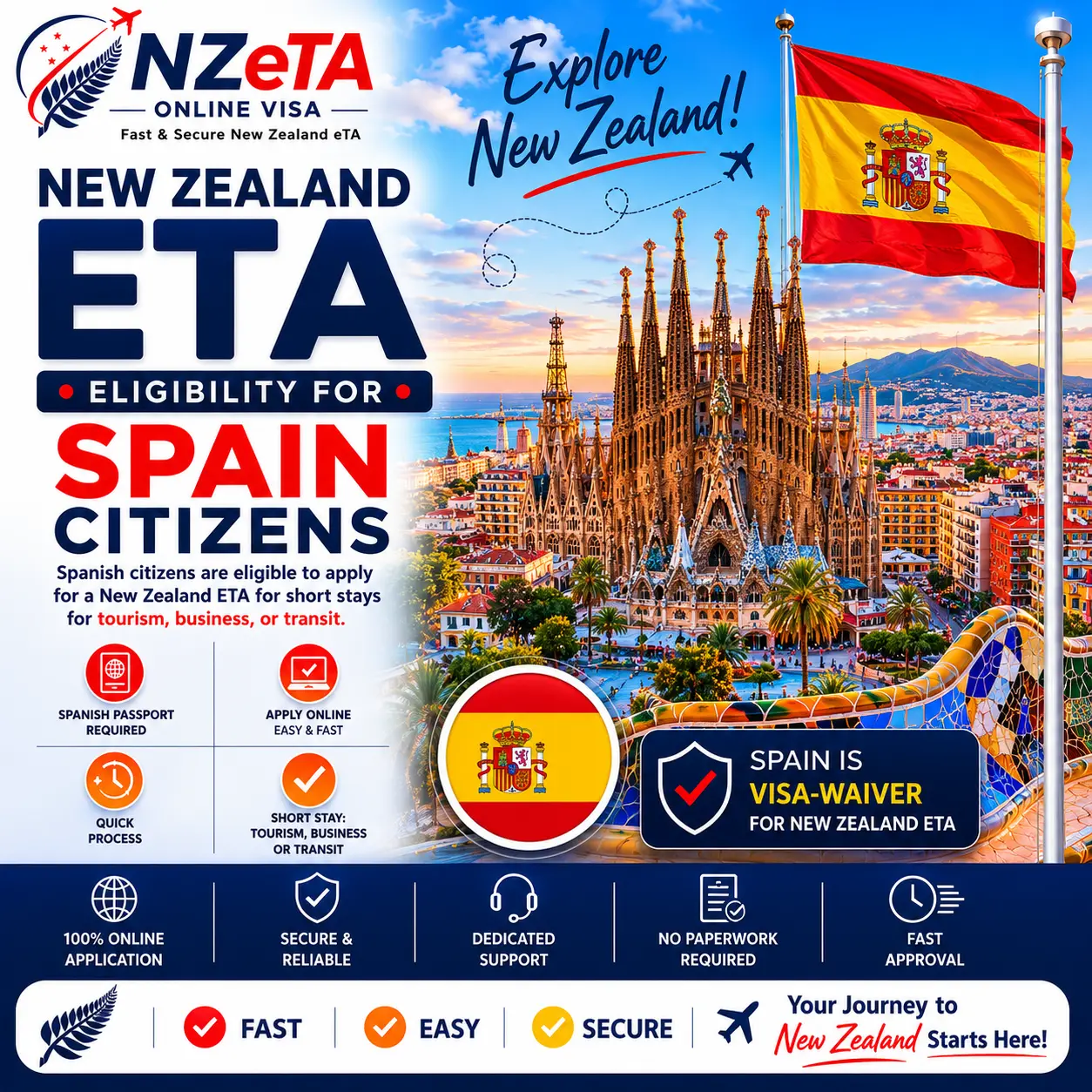
Spain has been a member of the European Union since 1986 and qualifies under New Zealand's visa-waiver programme. Spanish passport holders do not need a traditional tourist visa for eligible short visits to New Zealand — the New Zealand Electronic Travel Authority (NZeTA) replaces it entirely. The application is 100% online, requires no embassy visit, and is approved within 72 hours.
Spain at a Glance
| Capital | Madrid |
| Population | ~48 million |
| Area | 505,990 km² |
| Currency | Euro (EUR) |
| Main Hub | Madrid (MAD) |
| EU Member | Since 1986 |
| Language | Spanish (Castilian) |
| Distance to AKL | ~19,400 km |
NZeTA Quick Facts
| Visa needed? | No — NZeTA only |
| Application | Online, no embassy |
| Processing | ~72 hours |
| Validity | 2 years |
| Entries | Multiple |
| Max stay | 90 days |
Four Reasons Spanish Travellers Choose New Zealand
Spain and New Zealand are, in global terms, natural counterparts — both countries where landscape, food, wine, and outdoor culture are intertwined into national identity. Spanish travellers who understand Rioja, the Camino, and Picos de Europa will find New Zealand operates on the same values, expressed in a completely unfamiliar vocabulary.
World-Class Wine
Spain's La Rioja and Ribera del Duero are global benchmarks. New Zealand's Marlborough and Hawke's Bay are equally serious — and the wine regions are accessible, scenic, and built for visitors.
Long-Distance Walking
The Camino de Santiago defines Spanish walking culture. New Zealand's Te Araroa (3,000 km end-to-end) and its nine Great Walks offer the same combination of challenge, landscape, and personal journey.
Extreme Natural Diversity
Spain has the Pyrenees, the Sierra Nevada, the Picos de Europa, and three coastlines. New Zealand has the Southern Alps, volcanic plateau, fiords, and 15,000 km of coastline — compressed into a smaller area with higher drama.
Living Cultural Identity
Flamenco, Sevillanas, and regional folk traditions are living cultural expressions in Spain. New Zealand's Māori kapa haka, whakairo carving, and tikanga customs carry the same quality — not museum culture but living, performed, and woven into daily life.
NZeTA Requirements for Spanish Citizens
All four items must be ready before opening the application form. Every detail must match your Spanish passport exactly — the application cannot be partially saved and resumed.
Spanish Passport
Biometric. Valid at least 3 months past your NZ departure. NZeTA is tied to this passport number — renewing your passport means a new NZeTA.
Digital Face Photo
Passport-style. Plain background, no sunglasses, full face visible, taken within the last 6 months. Uploaded in the online form.
Email Address
Your NZeTA approval is sent to this address. Keep it accessible at check-in in Madrid, Barcelona, or any Spanish departure airport.
Payment Card
Credit or debit card to pay the NZeTA processing fee and the mandatory NZ government IVL levy in one transaction. Non-refundable.
How to Apply — Four Steps Online
No embassy. No appointment. Apply from Madrid, Barcelona, Seville, or anywhere at our NZeTA application page. Apply at least 3 days before your departure.
Passport Details
Full name, date of birth, Spanish passport number and expiry — exactly as printed.
Photo & Declarations
Upload your face photo and answer all health and character declarations honestly.
Pay Fee & IVL
One secure card payment covers both the NZeTA service fee and the NZ government IVL levy. Instant confirmation.
Approved by Email
Approval within 72 hours. Linked electronically to your passport — no printing needed.
NZeTA — What It Covers and What It Does Not
The NZeTA is for short-term visits only. Confirm your travel purpose is covered before applying. See the tourist visa, business visa, and transit visa pages for activities requiring a separate visa.
Covered by the NZeTA
- Tourism, sightseeing, and leisure holidays throughout New Zealand
- Visiting family members or friends living in New Zealand
- Business meetings, trade events, conferences, and industry visits
- Short recreational activities or language courses under 3 months
- Transit through any New Zealand international airport
Requires a Separate Visa
- Paid employment or working for any New Zealand employer
- Study or formal education lasting longer than 3 months
- Planned medical treatment or elective healthcare procedures
- Stays exceeding 90 consecutive days
- Applying for New Zealand residency or permanent settlement
Flights from Spain to New Zealand
There are no direct flights from Spain to New Zealand. Madrid Barajas International Airport (MAD) is Spain's primary long-haul hub, operated through Iberia (Oneworld) with excellent one-connection options. Barcelona El Prat (BCN) offers similar long-haul access via Vueling, Qatar Airways, and Emirates. Journey time ranges from 22 to 28 hours depending on departure city and routing.
MAD is Spain's largest airport and one of Europe's best-connected hubs. Iberia, Qatar Airways, Emirates, and Singapore Airlines all offer direct services from Madrid to their respective hubs, with onward direct connections to Auckland.
Barcelona offers direct Qatar Airways and Emirates services to their hubs. Travellers from Andalusia can use Malaga (AGP) via a connecting European flight. Valencia (VLC) and Seville (SVQ) connect via Madrid or other European hubs.
Qatar Airways · direct both legs
1 stop · ~22–24 hrs
Emirates · direct both legs
1 stop · ~22–24 hrs
Iberia regional + long-haul connection
2 stops · ~25–28 hrs
Open-jaw itineraries — fly into Auckland (AKL) and depart from Christchurch (CHC) — are a practical option to cover both islands without backtracking. The NZeTA is valid at all New Zealand international airports.
Spain and New Zealand — Unexpected Parallels at Opposite Ends of the World
Spain and New Zealand share more than most long-haul destination pairs. Both are countries where national identity is inseparable from landscape, food, wine, and outdoor culture. The specific parallels below are not superficial — they represent the same values expressed at different latitudes and in completely different terrain.
Spain
La Rioja, Ribera del Duero & Priorat
Spain has 69 denominaciones de origen — more protected wine regions than any country except France. Tempranillo, Garnacha, and Albariño define Spain's wine identity. La Rioja's oak-aged reservas and gran reservas are global reference points for red wine aged to complexity.
New Zealand
Marlborough, Hawke's Bay & Central Otago
Marlborough Sauvignon Blanc set the world standard for the variety. Hawke's Bay's Syrah and Bordeaux blends and Central Otago's Pinot Noir are internationally collected. New Zealand's wine regions are small, beautiful, and built for wine tourism — the same approach as Rioja's bodegas.
Spain
Camino de Santiago — 800 km Across Northern Spain
The Camino Francés from Saint-Jean-Pied-de-Port to Santiago de Compostela is the world's most walked long-distance route — over 400,000 pilgrims per year. The combination of physical effort, daily distance, changing landscape, and arrival at a cathedral after weeks of walking is a singular experience.
New Zealand
Te Araroa — 3,000 km the Length of Both Islands
Te Araroa runs from Cape Reinga (Northland) to Bluff (Southland). At 3,000 km, it is nearly four times the Camino Francés. Section walkers — the equivalent of Camino day-stage pilgrims — can walk the Tongariro Alpine Crossing, the Tararua Ranges, or the Queen Charlotte Track and experience the same quality of sustained effort in extraordinary terrain.
Spain
Pyrenees, Picos de Europa & Sierra Nevada
Spain has three major mountain systems — the Pyrenees (shared with France), the Cantabrian Picos de Europa, and the Sierra Nevada (which contains Spain's highest peak, Mulhacén, at 3,479 m). Spanish hikers and skiers treat the mountains as essential terrain, not spectacle.
New Zealand
Southern Alps, Tongariro & Fiordland
New Zealand's Southern Alps run 500 km down the South Island's spine. Aoraki Mount Cook (3,724 m) is the highest point. But Tongariro's three active volcanoes in a single alpine crossing, and Fiordland's 1,200-metre cliff walls above still water, offer terrain that Spanish mountain walkers have no equivalent for at home.
Spain
Flamenco, Feria & Regional Folk Traditions
Flamenco — song, guitar, dance, and palmas — is a living art form with deep Andalusian roots, not a tourist performance. Spain's regional traditions (the Basque Aberri Eguna, Valencia's Las Fallas, Catalonia's castellers) demonstrate that folk culture in Spain is identity, not heritage.
New Zealand
Kapa Haka, Haka & Māori Living Culture
Māori kapa haka — the combination of haka (challenge), waiata (song), mōteatea (lament), and poi — is New Zealand's living cultural performance tradition. The All Blacks' pre-match haka carries the same function as flamenco's emotional charge: identity expressed through the body. The Waitangi Day national celebrations carry the same quality of living folk tradition as Spain's regional festivals.
Frequently Asked Questions — NZeTA for Spanish Citizens
Apply for Your New Zealand NZeTA — Spanish Citizens
100% online from Madrid, Barcelona, or anywhere in Spain. Approved within 72 hours. Valid 2 years with multiple entries.
Start NZeTA Application — Spanish Passport