República Argentina → Aotearoa New Zealand
Argentine Citizens Qualify for the New Zealand NZeTA — No Visa Required
Argentina is on New Zealand's visa-waiver list. Argentine passport holders do not need a traditional tourist visa for eligible short visits to New Zealand — the New Zealand Electronic Travel Authority (NZeTA) replaces it entirely. The application is 100% online, takes under five minutes, and is typically approved within 72 hours.
The NZeTA is electronically linked to your Argentine passport. Valid for 2 years with multiple entries, each stay up to 90 days. No physical document is issued — verified electronically at check-in and at the New Zealand border.
Apply for NZeTA — Argentine Passport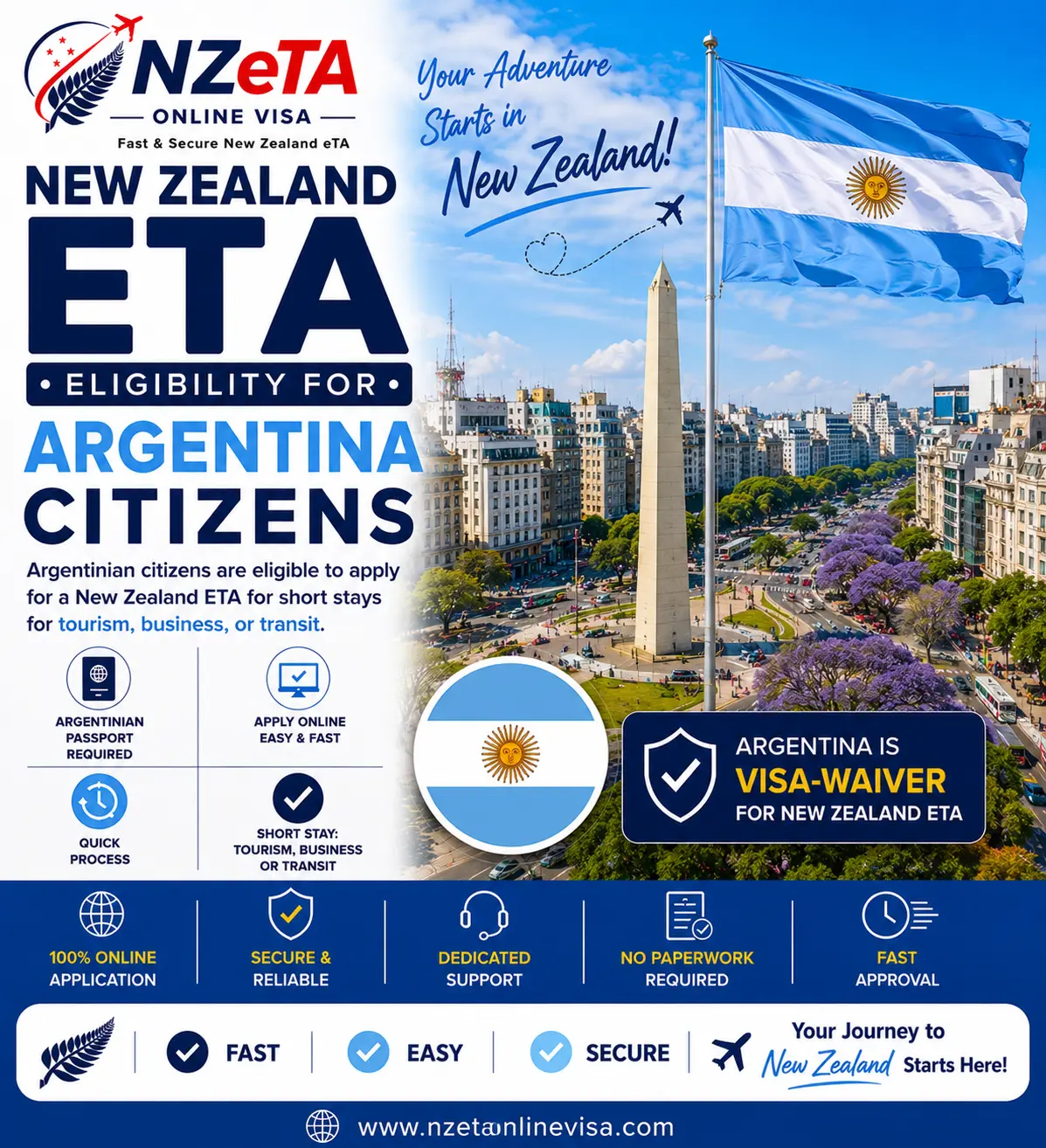
NZeTA Requirements for Argentine Citizens
All four items must be ready before opening the application form. Details must match your Argentine passport exactly.
Valid Argentine Biometric Passport
Must be valid for at least 3 months beyond your planned departure from New Zealand. The NZeTA is electronically tied to this passport number — if you renew your passport before travelling, a new NZeTA application is required. Non-biometric older passports are not accepted.
Recent Digital Face Photograph
A passport-style photograph taken within the last 6 months. Plain light background, no sunglasses or headwear (except for religious reasons), full face clearly visible. Uploaded directly into the online application — no physical print required at any stage.
Active Email Address
Your NZeTA approval is delivered by email. Keep it accessible at check-in at Buenos Aires Ezeiza (EZE) and at the New Zealand border on arrival. No physical document is issued — the NZeTA is verified electronically against your passport number.
Credit or Debit Card — Fee & IVL
One secure payment covers both the NZeTA processing fee and the mandatory New Zealand government IVL levy. Both are non-refundable. Argentina uses the Peso (ARS) — international card payments will be charged in NZD at your bank's exchange rate.
How to Apply — Four Steps, Fully Online
No embassy. No appointment. Apply from Buenos Aires or anywhere in Argentina at our NZeTA application page. Apply at least 3 days before your departure from Ezeiza.
Enter Passport Details
Full legal name, date of birth, Argentine passport number, and expiry date — exactly as printed in your passport. Cross-check every digit: a single error in the passport number will delay approval and must be corrected before the NZeTA can be issued.
Upload Photo & Declarations
Upload your recent digital face photograph and truthfully answer all mandatory health and character declaration questions. These are legal requirements under New Zealand immigration law — inaccurate answers are grounds for rejection and can affect future entry.
Pay NZeTA Fee & IVL Levy
Both the NZeTA service fee and the mandatory New Zealand government International Visitor Conservation and Tourism Levy are paid in one secure card transaction. Non-refundable. Instant payment confirmation is issued and your application enters processing immediately.
Approved by Email
Most applications are approved within 72 hours. The NZeTA is electronically linked to your Argentine passport — no printing needed. Airline check-in staff at Ezeiza and New Zealand border officers access it automatically on arrival.
NZeTA — Permitted and Restricted Activities
The NZeTA is for short-term visits only. See the tourist visa, business visa, and transit visa pages for activities requiring a separate visa.
Covered by the NZeTA
Requires a Separate Visa
Flights from Argentina to New Zealand
There are no direct flights from Argentina to New Zealand. Both countries are in the Southern Hemisphere but on opposite sides of the Pacific Ocean — making this one of the world's longer journeys. Buenos Aires Ezeiza (EZE) is Argentina's main international hub. Total journey time ranges from 24 to 32 hours depending on routing.
Route Overview — Buenos Aires to Auckland
Open-jaw itineraries — arriving Auckland (AKL), departing Christchurch (CHC) — let Argentine travellers cover both islands without backtracking. The NZeTA is valid at all New Zealand international airports. Buenos Aires ARS currency note: New Zealand uses NZD. Contactless card payment is standard across New Zealand.
Argentina and New Zealand — A Southern Hemisphere Duel
Argentina and New Zealand are both Southern Hemisphere nations shaped by vast landscapes, indigenous cultures, European settlement, and a relationship with nature that defines national identity. They share a latitude belt, a beef culture, a mountain soul, and an outsized opinion of their own football/rugby respectively. The differences between them are precisely what makes the journey extraordinary.
Patagonia & Perito Moreno Glacier
The Patagonian steppe, the Torres del Paine border region, the Perito Moreno Glacier calving into Lago Argentino — Argentina's southern landscapes are among the most dramatic on earth, defined by wind, ice, and geological scale.
Fiordland & Franz Josef Glacier
Fiordland's 1,200-metre cliff walls above still water and Franz Josef Glacier descending into temperate rainforest carry the same combination of ice, scale, and emptiness. Argentine Patagonia travellers arrive in the South Island with immediate landscape recognition.
Rugby & Fútbol — Los Pumas and La Albiceleste
Argentina's sports identity is split between the world passion (football, with Messi and three World Cup titles) and a serious rugby tradition (Los Pumas, one of the world's top ten nations). Sport is not entertainment in Argentina — it is the national emotional vocabulary.
Rugby & The All Blacks
New Zealand's All Blacks are the most successful rugby team in history, with a win rate above 75% across 130 years. Rugby in New Zealand carries the same cultural weight as football in Argentina — it is identity expressed through sport. The two nations have met repeatedly in Rugby Championship, each match carrying disproportionate national significance.
Asado & Beef Culture
Argentina consumes more beef per capita than almost any nation on earth. The asado — slow-grilled on a parrilla over wood coals — is not a cooking method but a social ceremony. The quality of the beef, the patience of the cook, and the gathering of family and friends define the asado as a cultural institution.
Lamb, Beef & the Hāngī
New Zealand is one of the world's largest exporters of lamb and beef. Its own fire-and-food ceremony is the Māori hāngī — meat and vegetables slow-cooked in an earth pit using heated stones. Both cultures have built a communal outdoor-cooking tradition that is genuinely ceremonial rather than purely functional.
Tango & Living Cultural Performance
Tango — born in the working-class conventillos of Buenos Aires and Montevideo in the late 19th century — is a living global art form, UNESCO Intangible Cultural Heritage. Milongas are danced in Buenos Aires street corners, community centres, and dedicated dance halls every night of the week.
Kapa Haka & Haka
New Zealand's kapa haka — the combination of haka challenge, waiata song, mōteatea lament, and poi — is the living Māori cultural performance tradition. Like tango, it emerged from a specific community at a specific moment in history, and remains performed live in community contexts, schools, and national events. Both are movement-based cultural expressions carrying political and emotional weight.
Iguazú Falls — Where Three Borders Meet
Iguazú Falls — shared between Argentina and Brazil — is one of the world's most powerful waterfalls: 275 individual cascades spread over 2.7 km, with the Garganta del Diablo carrying over 1,700 cubic metres of water per second. Roosevelt called it "my poor Niagara" after seeing Iguazú.
Huka Falls, Sutherland Falls & Milford Sound Cascades
New Zealand's Huka Falls — where the Waikato River narrows to 15 metres before dropping — discharges 220,000 litres per second: not the height of Iguazú but the volume is overwhelming at close range. Sutherland Falls (580 m high) is one of the world's tallest falls. After heavy rain, Milford Sound's vertical cliff walls run with temporary waterfalls — a moving spectacle of water that rivals any permanent falls system in Argentina.
Frequently Asked Questions — NZeTA for Argentine Citizens
Apply for Your New Zealand NZeTA — Argentine Citizens
100% online from Buenos Aires or anywhere in Argentina. Approved within 72 hours. Valid 2 years with multiple entries.
Start NZeTA Application — Argentine Passport