Republic of Mauritius · Indian Ocean → Aotearoa New Zealand
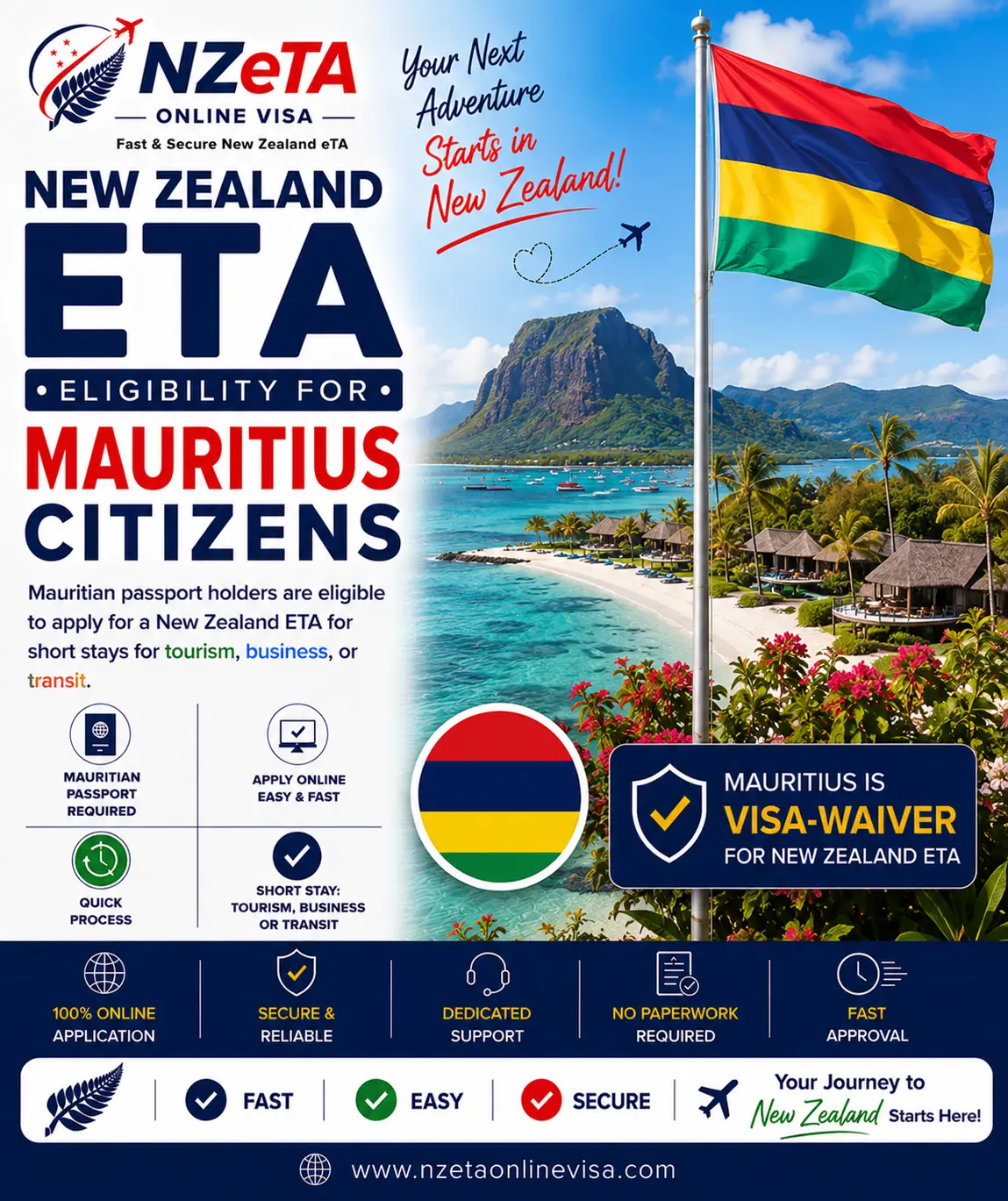
Mauritius Citizens Need a New Zealand NZeTA — Apply 100% Online
Mauritius is on New Zealand’s visa-waiver list. An approved NZeTA replaces the tourist visa entirely — no embassy, no appointment. Apply online, approved within 72 hours, valid 2 years.
Mauritius — An Island Shaped by Five Continents
Mauritius is a volcanic island nation in the southwestern Indian Ocean, approximately 2,000 km east of Madagascar and 900 km east of the nearest coastline of Africa. It has a total area of approximately 2,040 km² including the smaller islands of Rodrigues, Agaléga, and Saint Brandon. Its population of approximately 1.27 million is one of the most ethnically diverse in the world — the legacy of successive waves of settlement: French colonists, enslaved Africans, Indian indentured labourers, Chinese traders, and British administrators each left permanent cultural marks. The national language is Mauritian Creole; French and English are official languages.
Mauritius has never had an indigenous human population — it was uninhabited until Dutch settlers arrived in 1638. The Dutch introduced sugarcane; the French developed Port Louis into a trading hub; the British arrived in 1810 and brought the largest wave of Indian workers to run the sugar plantations. Today, approximately 68% of the population is of Indian descent, approximately 27% Creole (of African and mixed heritage), and around 3% Chinese. This is a country that was built entirely from immigration across five continents.
Sir Seewoosagur Ramgoolam International Airport (MRU) near Mahébourg is the country’s sole international airport. Air Mauritius (MK) is the national carrier. The most efficient routes to New Zealand connect through Perth or Melbourne on the Indian Ocean–Australia corridor, with total journey times of approximately 17 to 20 hours.
NZeTA Requirements for Mauritius Citizens
All four items must be ready before opening the NZeTA application. All details must match your Mauritius passport exactly.
Valid Mauritius Biometric Passport
Your Mauritius passport must be biometric and valid for at least 3 months beyond your planned departure from New Zealand. The NZeTA is electronically linked to your specific passport number — renewing before travel requires a new NZeTA application. Mauritius passports are widely accepted internationally; the NZeTA ensures New Zealand-specific pre-clearance.
Recent Digital Face Photograph
A passport-style photograph taken within the last 6 months. Plain light background, no sunglasses, no headwear except for religious reasons, full face clearly visible and centred. Uploaded directly into the online form — no printed photograph is required at any stage.
Active Email Address
Your NZeTA approval is sent by email. Keep this address accessible at check-in at MRU and on arrival in New Zealand. The NZeTA is verified electronically at the border — no printed document is required from the traveller. Ensure the email address is accessible throughout your journey.
Payment Card — NZeTA Fee & IVL
A credit or debit card to pay the NZeTA processing fee and the mandatory NZ government International Visitor Conservation and Tourism Levy (IVL) in one secure transaction. Non-refundable. Mauritius uses the Mauritian Rupee (MUR) — your bank converts to NZD at the prevailing rate. Major international cards (Visa, Mastercard) are accepted.
How to Apply for the NZeTA — Mauritius Citizens
No embassy. No appointment. Apply from Port Louis or anywhere at our NZeTA application page. Apply at least 3 days before your MRU departure.
Enter Your Mauritius Passport Details
Full legal name, date of birth, Mauritius passport number, and expiry date — exactly as printed in your passport. A single error in the passport number will delay processing. The name must be romanised exactly as it appears on your passport data page.
Upload Photo & Complete Health Declarations
Upload your digital face photograph and truthfully answer all health and character declaration questions. Required by New Zealand immigration law — inaccurate answers may result in rejection and affect future entry. Declarations are in English and typically take 3 to 5 minutes to complete.
Pay NZeTA Fee & IVL Levy
The NZeTA service fee and the New Zealand government IVL levy are collected together in one secure online card transaction. Non-refundable. Instant payment confirmation is sent and your application enters processing immediately after successful payment.
Receive Your NZeTA Approval by Email
Approved within 72 hours. The NZeTA is electronically linked to your Mauritius passport — no printing required. Check-in staff at MRU and New Zealand border officers at Auckland (AKL) verify it automatically when you present your passport on departure and arrival.
NZeTA — What It Covers and What Requires a Separate Visa
The NZeTA covers short-term visits only. See the tourist visa, business visa, and transit visa pages for activities requiring a separate visa.
Covered by the NZeTA
- ✓ Tourism, sightseeing, and leisure travel throughout New Zealand
- ✓ Visiting family or friends resident in New Zealand
- ✓ Business meetings, conferences, and trade events (no paid work)
- ✓ Hiking Great Walks, adventure activities, diving, skiing, watersports
- ✓ Short courses or workshops lasting under 3 months
- ✓ Airport transit through any New Zealand international airport
Requires a Separate Visa
- ✕ Paid employment or working for a New Zealand employer — work visa required
- ✕ Study or education lasting more than 3 months — student visa required
- ✕ Planned medical treatment or procedures — medical visa required
- ✕ Stays exceeding 90 consecutive days or residency applications
Flights from Mauritius to New Zealand
All flights from Mauritius to New Zealand depart from Sir Seewoosagur Ramgoolam International Airport (MRU) near Port Louis. There are no direct flights — all routes connect through an Australian gateway city or Gulf hub.
MRU → PER (Air Mauritius ~7 hrs) → AKL (Air NZ or Qantas ~6 hrs)
The Perth routing via Air Mauritius MK564 is the most direct Indian Ocean path to New Zealand. Perth is well positioned as a single connection point for this corridor.
MRU → MEL (Air Mauritius ~10 hrs) → AKL (Air NZ ~3 hrs)
~17–20 hrs · 1 connectionMRU → DXB (Air Mauritius or Emirates ~5.5 hrs) → AKL (Emirates ~17 hrs)
The Emirates via Dubai routing is a comfortable single-connection option with generous Business and Economy amenities. Emirates DXB–AKL operates approximately 3–4 times weekly. Total journey is longer than the Australian routing (~24 hours) but offers more cabin service options.
~24 hrs · 1 connectionMauritius uses the Mauritian Rupee (MUR). New Zealand uses NZD. Contactless Visa/Mastercard payment is universal across New Zealand. An open-jaw itinerary — arriving Auckland (AKL) and departing Christchurch (CHC) — covers both islands efficiently without backtracking.
Six Cultural Layers in Mauritius — and What Each Finds in New Zealand
Every wave of settlement that shaped Mauritius left a cultural tradition that continues today. When Mauritius travellers arrive in New Zealand, each heritage finds something unexpected in a Pacific nation built by a very different kind of immigration story.
Tamil, Hindi, Bhojpuri, and Urdu traditions run deep in Mauritius — Diwali is a national public holiday, and temples stand alongside mosques on the same street. Indian cuisine, textiles, and music define daily Mauritian life.
NZ echo: Auckland has one of the world’s largest Pacific Indian communities. Bollywood films screen in Auckland cinemas, and Diwali is celebrated in Aotearoa Square with crowds of thousands. Mauritians of Indian descent find their food, their language, and their festivals already present in New Zealand.
French is co-official in Mauritius, and the French legacy shows in architectural style, cuisine (rougaille, daube), and the island’s foundational legal tradition. The Académie française-influenced media and education system are firmly Francophone.
NZ echo: New Zealand shares French colonial heritage in the South Pacific — French Polynesia, New Caledonia, and Vanuatu are part of the regional story. Akaroa, on Banks Peninsula, was a French settlement whose colonial character survives visibly today, including French street names and architecture.
Creole culture — born from the fusion of African, Malagasy, and European influences — gave Mauritius its most distinct musical tradition: Sega. Sega is the island’s heartbeat — rhythmic, percussive, and danced barefoot on sand. The Creole language is the mother tongue of virtually all Mauritians, regardless of ancestry.
NZ echo: Māori culture’s relationship with land, music, and oral tradition resonates with Creole culture’s similar rootedness in place. Kapa haka and sega are different in form but share a quality of culture expressed through the body, in performance, as community rather than spectacle.
The Chinese Mauritian community — descended primarily from Hakka traders who arrived in the 19th century — shaped the commercial culture of Port Louis. Chinese New Year is celebrated island-wide. Mauritian-Chinese fusion food (dim sum with rougaille) exists only in Mauritius.
NZ echo: New Zealand has a significant and long-established Chinese community, particularly in Auckland and Dunedin (where Chinese gold miners arrived in the 1860s). Chinese language schools, community centres, and restaurants operate across both islands — Mauritians of Chinese heritage find a familiar community presence.
The Creole population carries the legacy of enslaved Africans and Malagasy people brought to Mauritius by Dutch and French colonists. The Aapravasi Ghat in Port Louis (UNESCO Heritage Site) commemorates the arrival of Indian indentured workers; the Le Morne Brabant (also UNESCO) is the symbol of enslaved African resistance.
NZ echo: New Zealand’s Pacific communities — Samoan, Tongan, Fijian, Cook Island — carry their own histories of displacement and migration. Auckland is home to the world’s largest Polynesian urban population. The story of forced movement followed by cultural resilience is one New Zealand and Mauritius share in different forms.
British rule from 1810 to 1968 gave Mauritius its parliamentary democracy, common law legal system, English-medium education, and cricket culture. The Port Louis racecourse — one of the oldest in the Southern Hemisphere — is a direct British legacy, as is Mauritius’s membership of the Commonwealth.
NZ echo: New Zealand is a Westminster parliamentary democracy, a Commonwealth member, and one of the world’s great cricket nations. The shared British institutional layer means Mauritius citizens navigate New Zealand’s legal, political, and social systems with an existing frame of reference that makes the country feel familiar in structure, if not in landscape.
Frequently Asked Questions — NZeTA for Mauritius Citizens
Apply for Your New Zealand NZeTA — Mauritius Citizens
100% online from Port Louis or anywhere in Mauritius. Approved within 72 hours. Valid 2 years with multiple entries.
Start NZeTA Application — Mauritius Passport