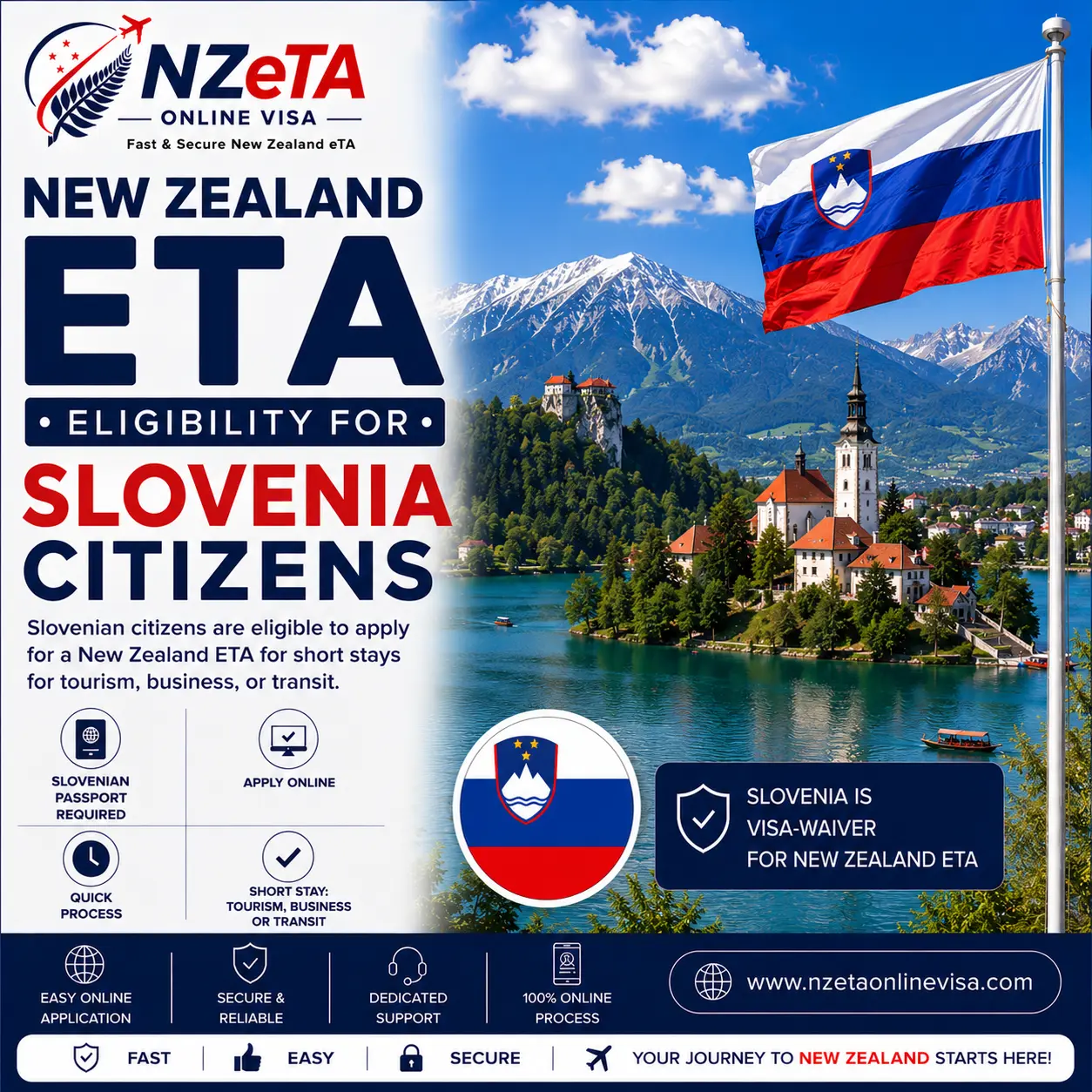
Slovenian Passport Holders Qualify for the New Zealand NZeTA — No Embassy Visit Required
Slovenia joined the European Union in 2004 and participates in New Zealand's visa-waiver programme. Slovenian citizens do not need a traditional tourist visa for eligible short stays — instead, a New Zealand Electronic Travel Authority (NZeTA) must be approved before departure. The application is entirely online, takes under five minutes, and is typically processed within 72 hours.
The NZeTA is electronically linked to your Slovenian passport — no physical document is issued. It is valid for 2 years with multiple entries allowed, each stay up to 90 days.
Three Landscapes in One Country — Why Slovenian Travellers Feel at Home in New Zealand
Slovenia is one of Europe's most geographically compact countries — yet within 20,273 km² it contains three completely distinct terrain types: the Julian Alps, the Karst limestone plateau, and a short but significant Adriatic coastline. New Zealand mirrors this compressed variety at a far larger scale. Slovenian travellers who already live in a country shaped by mountains, caves, and coast find that New Zealand speaks a familiar language — in a completely unfamiliar voice.
Slovenia: Triglav National Park surrounds Mount Triglav (2,864 m), the country's only national park and its defining national symbol. The turquoise Soča River, glacial Lake Bohinj, and multi-day Slovenian Mountain Trail define Alpine Slovenia.
New Zealand equivalent: Fiordland National Park (the largest in NZ), Aoraki Mount Cook National Park, and the Milford and Routeburn Tracks match Triglav's scale — and exceed it. The Hollyford Valley's glacially carved walls and the West Coast's emerald rivers carry the same mineral-green intensity as the Soča.
Alpine → Fiordland · Mount CookSlovenia: The word "karst" comes from the Slovenian Kras plateau — Slovenia gave the world the term for this type of landscape. Postojna Cave (24 km of passages, five million annual visitors) and the UNESCO-listed Škocjan Caves are among the world's most visited underground systems.
New Zealand equivalent: Waitomo Glowworm Caves offer something impossible in the Karst — underground rivers lit entirely by bioluminescent glowworms (Arachnocampa luminosa) found nowhere else on earth. For Slovenians who literally named cave landscapes, Waitomo is the system that does something Postojna cannot.
Karst → Waitomo · Nelson CavesSlovenia: Ljubljana — named European Green Capital 2016, the first Central/Eastern European city to receive this title — is walkable, architecturally rich (Jože Plečnik's iconic bridge and market), and defined by the Ljubljanica river and the castle overlooking the old town.
New Zealand equivalent: Wellington shares Ljubljana's compact character, café culture, and cultural concentration — the Te Papa national museum, the cable car, a harbour setting, and Cuba Street's creative scene. Both cities punch well above their population weight culturally.
Ljubljana → WellingtonWhat Slovenian Citizens Need to Apply for the NZeTA
Gather all four items before opening the application form. Details must exactly match your Slovenian passport — the form cannot be saved partially and resumed.
Apply at least 3 days before departure from Ljubljana, Venice, or Zagreb. Processing is typically complete within 72 hours, but applying early avoids last-minute complications.
Must be valid for at least 3 months beyond your planned departure date from New Zealand. The NZeTA is tied electronically to your passport number — if you renew your passport before travelling, you must submit a new NZeTA application. Non-biometric (older) passports are not accepted under the visa-waiver programme.
A passport-style photograph taken within the last 6 months. Plain light background, no sunglasses or headwear (except for religious reasons), full face clearly visible. Uploaded directly in the online application form — no physical print required.
Your NZeTA approval is sent by email. Keep this email address accessible at check-in at whichever airport you depart from (Ljubljana LJU, Venice VCE, Zagreb ZAG, or Vienna VIE) and at New Zealand's border on arrival. No physical document is printed.
Pay the NZeTA processing fee and the mandatory New Zealand government International Visitor Conservation and Tourism Levy (IVL) together in one secure online transaction. Both charges are non-refundable once submitted. The IVL funds New Zealand's conservation and tourism infrastructure.
How to Apply for the NZeTA — Slovenian Citizens
Four steps, fully online. Apply at our NZeTA application page at least 3 days before your scheduled departure.
Enter Your Slovenian Passport Details
Full legal name, date of birth, Slovenian passport number, and expiry date — exactly as printed in your passport. A single error in the passport number will prevent the NZeTA from being matched to you at check-in and must be corrected before approval can proceed.
Upload Your Photograph & Complete Declarations
Upload your digital face photograph and answer the mandatory health and character declaration questions. These are legal requirements under New Zealand immigration law — inaccurate or incomplete answers are grounds for rejection and may result in future entry refusals.
Pay the NZeTA Processing Fee & IVL Levy
Both the NZeTA service fee and the New Zealand government IVL levy are collected in a single secure card payment. Payment is non-refundable and confirms submission. Instant payment confirmation is issued — application then enters processing.
Receive Your NZeTA Approval by Email
Most Slovenian applications are approved within 72 hours. The NZeTA is electronically linked to your Slovenian passport — no printing is required. Airline check-in staff and New Zealand border officers access it automatically. Keep the approval email accessible as a reference.
NZeTA Permitted Activities for Slovenian Citizens
The NZeTA is valid for short-term visits only. Confirm your travel purpose falls within a covered category before applying. For activities not covered, see the tourist visa, business visa, and transit visa pages.
Flights from Slovenia to New Zealand
There are no direct flights from Slovenia to New Zealand. Ljubljana Jože Pučnik Airport (LJU) is a small regional airport — most Slovenian travellers use nearby international airports for better long-haul options. Journey times to Auckland range from 22 to 28 hours depending on departure airport and routing.
Best Option: One-Connection Routes (22–24 hrs)
Drive to Venice or Zagreb to access direct Qatar Airways or Emirates service to their hubs, then onward direct to Auckland. This is the most efficient routing available from Slovenia.
Two-Connection Routes via Ljubljana (LJU) or Vienna (VIE)
Ljubljana Airport offers Wizz Air and easyJet European connections — these require a second connection in Asia or the Middle East. Vienna (3 hrs from Ljubljana) adds Austrian Airlines for a stronger long-haul connection.
Wizz Air + Lufthansa + Singapore Airlines
2 stops · ~25–27 hrs
easyJet + Singapore Airlines
2 stops · ~26–28 hrs
Austrian Airlines + Qatar Airways
1 stop · ~22–24 hrs
Many Slovenian visitors book an open-jaw ticket — arriving into Auckland (AKL) and departing from Christchurch (CHC) — to see both the North and South Islands without doubling back. The NZeTA is accepted at all New Zealand international airports.
Slovenia and New Zealand — Unlikely Parallels at Opposite Ends of the Earth
Slovenia is 20,273 km² — smaller than Switzerland, with a population of just over 2 million. New Zealand is 268,021 km² — twelve times larger, with 5 million people. Yet the two nations share a structural similarity that is difficult to explain and immediately felt: compact nations that contain entire worlds within their borders, where the landscape is not decoration but identity.
Soča River → West Coast Glacial Rivers
The Soča — emerald-green, clear, and cold through the Julian Alps — is one of Europe's most extraordinary rivers. The word "emerald" barely covers it: the colour comes from the dissolved limestone minerals, not algae. New Zealand's West Coast rivers fed by the Southern Alps carry the same mineral-green intensity — the Hokitika, the Waiho near Franz Josef Glacier, and the Waitaki tributaries. Slovenian kayakers and rafters who have paddled the Soča will find the Shotover Canyon and Kaituna River in New Zealand offering equal adrenaline in equivalent settings.
Lake Bled → Lake Tekapo & Lake Wānaka
Lake Bled — island church, clifftop castle, Julian Alps backdrop — is the image every Slovenian travel poster uses for good reason: it looks constructed rather than natural. New Zealand's Lake Tekapo, with its turquoise colour from glacial flour and the Church of the Good Shepherd built on its rocky shore, produces the same response in visitors: that this cannot be a real place. Lake Wānaka, surrounded by the Buchanan Peaks and bisected by a solitary willow tree, carries the same quality. Both countries produce views people assume must be composited until they stand in front of them.
Postojna & Škocjan → Waitomo Glowworm Caves
Slovenia is home to Postojna Cave — 24 km of passages — and the UNESCO-listed Škocjan Caves, which contain one of the world's largest underground canyons. New Zealand's Waitomo Glowworm Caves offer something neither Postojna nor Škocjan can: an underground river journey through caverns lit entirely by thousands of living bioluminescent glowworms (Arachnocampa luminosa), an organism found only in New Zealand and eastern Australia. The silence and the blue-white light are unlike any cave experience in Slovenia or anywhere in Europe.
60% Forest Cover → New Zealand Native Bush
Slovenia has the third-highest proportion of forest cover in the EU — approximately 60% of its land area is forested. The old-growth beech forests of the Kočevje region are among Europe's most ancient continuous woodlands. New Zealand's native bush — kahikatea, rimu, tōtara, kauri, and massed tree ferns — has the same quality of ancient, enclosed, living landscape. The Waipoua Forest's two largest kauri trees (Tāne Mahuta and Te Matua Ngahere) are the forest giants that carry the same weight of presence as the oldest Slovenian beeches.
Predjama Castle → Moeraki Boulders & Punakaiki Rocks
Predjama Castle — constructed into the mouth of a 123-metre cliff cave — is one of the world's most dramatic man-made sites: architecture that treats geology as a building material. New Zealand has no medieval castles, but it offers geological formations of equivalent visual impact: the Moeraki Boulders (huge spherical concretions on the Otago coast), the Punakaiki Pancake Rocks (layered limestone stacks above surging blowholes), and the basalt organ-pipe columns of Banks Peninsula. These are formations that produce the same disbelief that Predjama's cliff-face building inspires.
Ljubljana Green Capital → New Zealand 100% Pure
Ljubljana was named European Green Capital 2016 — the first city in Central or Eastern Europe to receive the designation. Slovenia has committed to becoming the world's first fully green tourism destination. New Zealand's 100% Pure brand is the world's best-known green tourism identity — a country that defines itself entirely by its natural landscapes, clean waterways, and endemic wildlife found nowhere else on earth. For Slovenian travellers who already live and breathe sustainability, New Zealand is the natural long-haul destination: a country that takes conservation as seriously as Slovenia does.
Frequently Asked Questions — NZeTA for Slovenian Citizens
Apply for Your New Zealand NZeTA — Slovenian Citizens
Fully online. No embassy. Approved within 72 hours. Valid 2 years with multiple entries.
Start NZeTA Application